Guides
Coworking space meeting room pricing: hourly vs monthly passes
Coworking space meeting room pricing splits into hourly rates, monthly passes and bundled credits. Here is how US operators set each and where the models break down.
What to take away
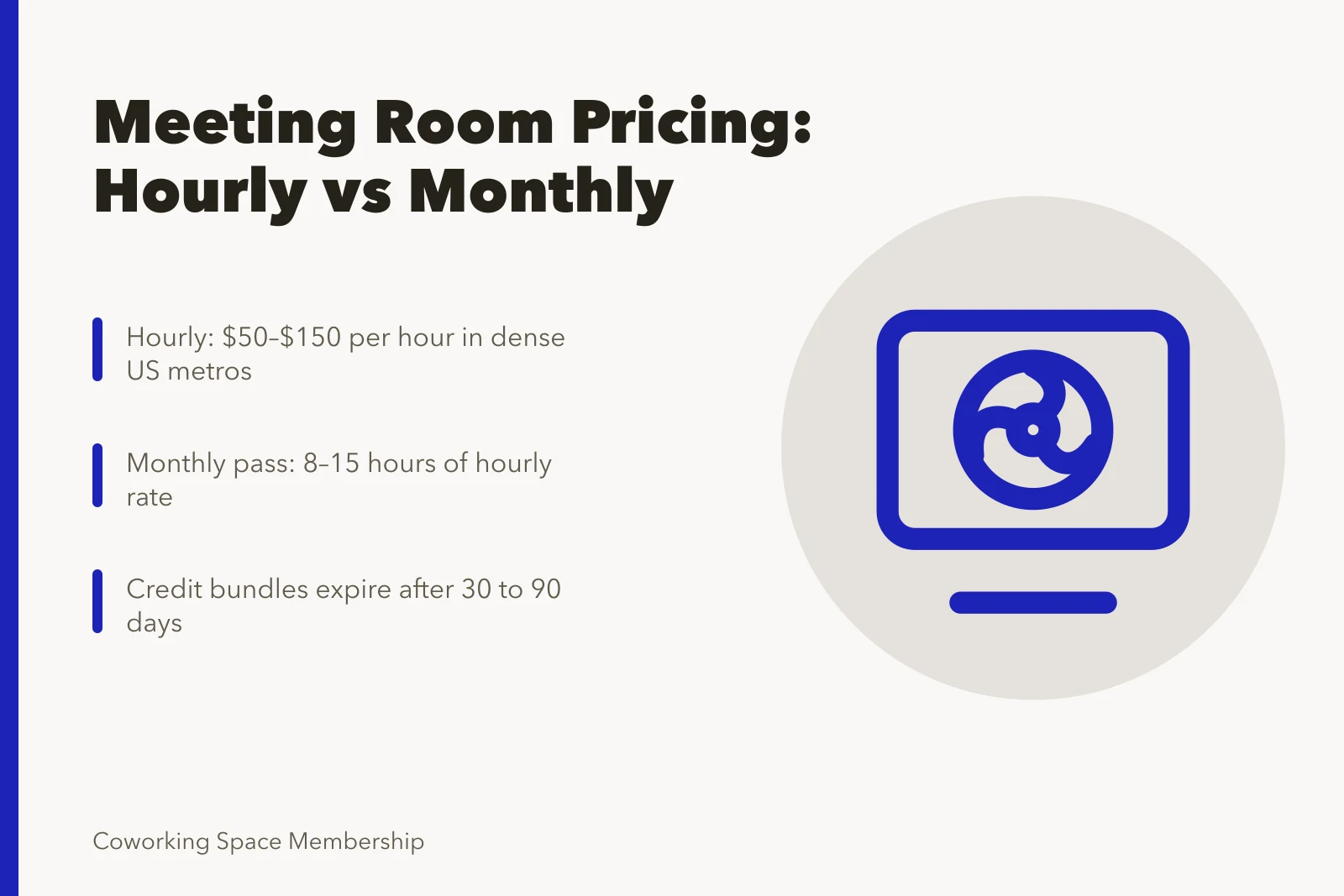
- Hourly rates in dense US metros commonly run $50 to $150 per hour for a four to eight person room, while smaller Midwest markets often sit at $25 to $60. Treat those as illustrative ranges, not published averages.
- Monthly meeting room passes usually price at 8 to 15 hours of the same room's hourly rate, which rewards members who book often and predictable.
- Bundled credits suit operators whose rooms sit empty midweek; pure hourly suits buildings with steady walk-in demand.
- No model fixes the real problem: a room that is empty at 2pm Tuesday and oversubscribed at 10am Thursday.
The three pricing models in play
Most US coworking operators pick one of three structures for meeting space. Pure hourly rental charges per booked hour with no commitment. A monthly pass gives a set bucket of hours or unlimited access for a flat fee. A credit bundle sits between them, selling blocks of hours that expire after 30 to 90 days.
Each model answers a different question. Hourly asks who needs the room right now. Monthly asks who needs it every week. Credits ask who needs it sometimes but hates filling out a booking form each time.
The choice rarely follows a formula. It follows the tenant mix, the lease terms on the room itself, and how much staff time the operator can spend chasing bookings. Operators weighing the wider revenue picture should read membership revenue tax treatment before locking a structure into a member agreement.
The criteria that matter
Four criteria separate a workable model from a painful one: revenue predictability, room utilization, administrative load, and how easily a member can predict their own bill.
| Criterion | Hourly rental | Monthly pass | Credit bundle |
|---|---|---|---|
| Revenue predictability | Low | High | Medium |
| Utilization effect | Fills peak hours | Fills off-peak | Fills off-peak |
| Admin load | High (per booking) | Low | Medium |
| Member bill clarity | High | High | Medium |
| Typical US price signal | $25 to $150 per hour | $200 to $1,200 per month | $150 to $600 per block |
Those dollar figures are illustrative ranges drawn from how operators describe their own rate cards in dense metros versus secondary markets. They are not a survey result and should not be quoted as one.
Option by option
Hourly rental
Hourly works where demand is spiky and the address is expensive. A Manhattan or downtown Chicago operator can charge $100 or more per hour for a room that seats eight, because the alternative for the member is a hotel business center at a similar or higher rate.
The downside is administrative. Every booking needs a confirmation, a room reset, and often a staff member to handle overruns. Operators who underprice hourly rooms usually discover it when a member books four hours and stays six.
Monthly pass
A monthly pass is right for the member who runs standing client meetings, interviews, or a weekly team session. It converts an unpredictable line item into a fixed cost, which many small firms prefer for budgeting. For the operator, it locks in revenue before the month starts.
Set the pass price against your own hourly rate rather than a competitor's. A pass priced at 10 hours of your hourly rate means a member who books 12 hours is ahead, and one who books six is not. That is the intended shape.
Credit bundles
Credits draw members who want a discount without a recurring charge. Unused hours expire, creating breakage. That breakage is real revenue, but it also drives member complaints at renewal.
Explain expiry in writing before the first purchase. If you hold funds against future use, check how your state treats prepaid service balances under security deposit law.
Where each one wins
Hourly wins in New York, San Francisco, Boston and Washington, where transient demand and high rents make every unsold hour expensive. Operators in those markets should price the room against local hotel and conference center rates, not against other coworking spaces alone.
Monthly passes win in midwest and secondary markets such as Columbus, Kansas City, and Grand Rapids. Demand is steadier, walk-in traffic is thinner, and members value a predictable bill more than a low peak rate.
Credit bundles win for hybrid operators with a mix of freelancers and small firms, and for rooms that sit empty on Friday afternoons. They are the compromise model, and compromises show up in the complaint log.
A pricing model is a guess about when your rooms will be empty. Check the guess against your booking log every quarter, not every year.
What none of them solve
No pricing model creates demand at the wrong hour. A room that is empty Tuesday at 2pm stays empty whether you sell it by the hour, the month, or the credit. Operators who want to move that inventory usually need scheduling incentives, not a new rate card.
Capacity limits are the second shared problem. Fire codes and local occupancy rules cap how many people a room can hold. A room priced for eight that legally holds six is a liability, not a revenue line.
The NFPA codes and standards list is the starting point for capacity and egress questions. Your local fire marshal has the final word.
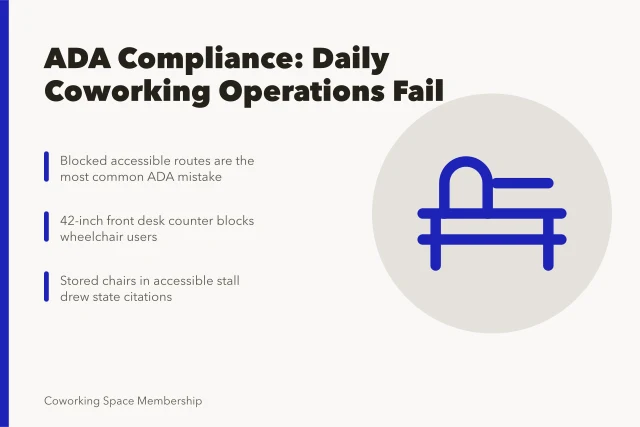
Accessibility obligations apply to the room itself, not just the lobby. Under Title III of the ADA, a meeting room in a place of public accommodation has to be usable, which affects table height, aisle width, and how you describe the room online. Operators who ignore that end up refunding bookings they cannot legally host.
Finally, none of these models tell you whether the room is worth its square footage. A 200 square foot room earning $400 a month may be worse than a hot desk at the same footprint. Run that comparison before you add a fourth pricing tier. For the wider operational picture, see measuring service quality.
Common questions
Should I offer both hourly and monthly rates? Yes, if you have more than one room. Price the monthly pass against your own hourly rate so the discount is deliberate rather than accidental. Two rooms let you test both models without cannibalizing one.
How many hours should a monthly pass include? Most operators land between 8 and 15 hours of equivalent hourly value. Below 8 the pass looks stingy; above 15 you are effectively renting the room at a discount to your best customers.
Do meeting room fees count as membership revenue? Often they are treated separately, which matters for tax and for how you report occupancy. Review the distinction with your accountant before you bundle the two.
What is the biggest pricing mistake operators make? Pricing against the coworking space down the street instead of against the hotel business center and the member's real alternative. The second comparison is the one that sets your ceiling.