Guides
Coworking space security deposit laws by state: where operators slip
Coworking space security deposit laws by state mostly cover residential leases, not licenses. Copying those caps and deadlines creates compliance risk.
What to take away
- Most state security deposit statutes apply to residential leases, not coworking memberships.
- California caps residential deposits and requires a 21-day itemized return; copying that cap into a coworking agreement invites a dispute.
- Texas sets 30-day itemization rules for residential landlords; commercial coworking deposits usually fall outside them.
- A compliant deposit receipt carries the amount, date, space name, and any applicable state return deadline.
- A court can award double the deposit plus fees when an operator wrongfully withholds a deposit under a residential-style lease.
Most coworking operators treat a member deposit as a one-time risk fee, but state law may categorize it differently. security deposit rules vary by state, and many statutes were written for residential leases, not flexible workspace licenses.
The commercial lease problem behind coworking deposits
A coworking membership is usually a license to use space, not a residential tenancy. Most state deposit laws protect residential renters, so that distinction matters.
California Civil Code section 1950.5 caps residential security deposits but does not govern a coworking office agreement. Operators who copy residential deposit language into membership terms create obligations that may not exist and may mislead members.
Before drafting deposit language, review the membership agreement terms that control how deposits are handled. The same document should state whether the deposit is for damage, unpaid fees, or both. Without that statement, a court may fill the gap using state law the operator never intended.
California's cap and why operators misread it
California's Department of Consumer Affairs handles consumer complaints, but it does not regulate coworking deposit disputes. The state's residential deposit cap is two months' rent for unfurnished units and three months for furnished units. Many operator guides repeat that cap without noting that it applies to dwellings, not desks.
A California coworking space can charge a deposit above the residential cap if the agreement is a true license. The operator must still return the deposit according to the written terms. If the terms promise a 21-day itemized return, the operator must meet that deadline or face a breach claim.
Operators in California and New York should also review state insurance rules because deposit exposure often overlaps with property and liability coverage.
Texas handling rules and the itemization trap
Texas Property Code requires residential landlords to give a written description of damages and itemized deductions. The standard deadline is 30 days after the tenant moves out.
Coworking operators in Austin sometimes borrow that 30-day rule for their deposits. Doing so creates a contractual duty to itemize, even if the Texas statute does not cover a commercial license.
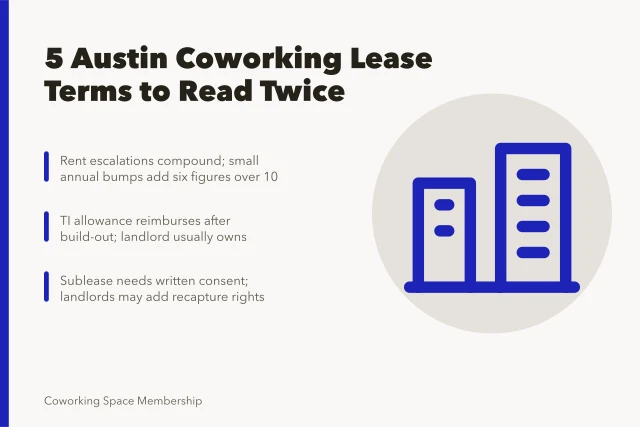
Austin coworking operators should read their lease terms twice before adding deposit clauses. A copied clause without the matching return process can produce a dispute when a member asks why no written itemization arrived. Texas courts enforce what the contract says, not what the operator assumed.
A compliant deposit receipt carries four facts
A compliant deposit receipt carries the amount paid, the date received, the name of the coworking space, and the state return deadline when one applies. Commercial security deposits are often documented poorly in coworking onboarding, which makes later disputes harder to defend. No federal agency regulates coworking deposit returns; state courts and small claims courts handle these cases.
Operators who collect a deposit without a receipt risk losing the ability to prove what was paid. A one-page receipt stored in the member file can prevent a he-said-she-said fight. The receipt itself is not a deposit law, but it is the first evidence a court will ask for.
What happens if you skip the deposit rules
A court can award double the deposit plus attorney fees in California residential cases when a landlord acts in bad faith. A coworking operator can face the same remedy if a court finds the agreement created a residential-style tenancy. Texas allows similar statutory damages for wrongful withholding.
If a court treats a coworking private office as a residential tenancy because the operator copied deposit language, the operator can owe double the deposit plus fees.
| State | Residential rule often pasted into coworking agreements | Where operators slip |
|---|---|---|
| California | Caps deposits and requires 21-day itemized return | Treating a license as residential creates double-damage exposure |
| Texas | Requires 30-day itemization and good faith handling | Copying the deadline without the process creates contract risk |
| New York | No general cap but strict return obligations in residential leases | Operators assume a cap exists and misstate it in terms |
A written deposit policy that states the return deadline, deduction conditions, and receipt process is the only reliable control. Operators should also check how a cancellation policy sample treats deposits when a member leaves early. Operators who rely on a remembered state cap or a friend's lease clause are the ones who end up in small claims court.
Common questions
Does California limit coworking space security deposits? No. California's security deposit cap applies to residential tenancies, not coworking licenses. A written agreement controls the amount.
Can a Texas coworking space keep a deposit without an itemized list? Only if the agreement permits it. Texas residential rules require itemization, but a commercial coworking license is governed by its own terms.
What must a coworking deposit receipt include? The amount, date, name of the space, and the applicable state return deadline if one exists.
What is the risk of calling a membership deposit a security deposit? A court may apply residential landlord-tenant law and award double the deposit plus fees for bad faith retention.