Guides
Coworking space membership agreement terms: what to write down first
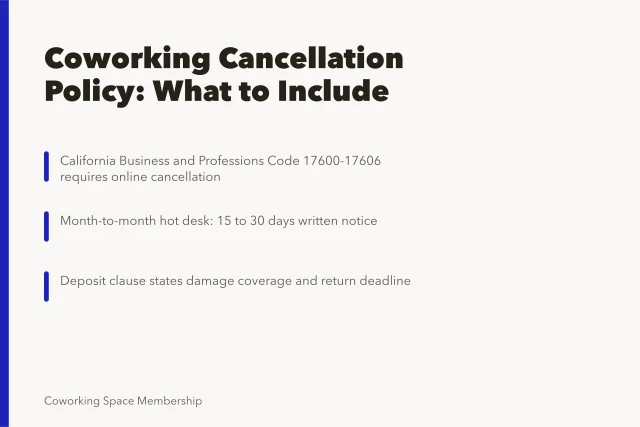
Coworking space membership agreement terms determine which promises hold up. This guide names the clauses to write first, from cancellation policy to auto-renewal.
What to take away
- A month-to-month agreement needs a different cancellation clause than an annual agreement.
- State law, not a single federal rule, controls auto-renewal and unilateral changes.
- Write the cancellation policy before you market the space.
- A missing renewal notice can extend an annual agreement for another full term in some states.
- Keep signed agreements and renewal notices for the term plus the state's contract claim period.
Who has jurisdiction over the agreement
US contract law is state law, and no federal regulator approves membership agreements; state attorneys general enforce consumer protection statutes. Courts resolve disputes under the state named in the agreement; if none, the operator's home state usually applies.
Auto-renewal and cancellation notice rules differ by state; California, New York, and Illinois impose specific notice periods for consumer service contracts. Some apply to business-to-business memberships depending on member size.
Operators negotiating a lease in New York City face additional terms that interact with membership agreements, as this Lease negotiation in New York City explains.
Month-to-month vs annual terms
The table below shows the main differences.
| Term | Auto-renewal default | Cancellation notice | Operator risk |
|---|---|---|---|
| Month-to-month | Renews monthly unless either side gives notice | Usually 30 days before next cycle | Member can leave quickly, so revenue shifts |
| Annual | May auto-renew for a full year unless notice sent by deadline | Often 30 to 60 days before end of term | Missing renewal notice can bind operator to another year |
State law can override the notice column. In some states, an annual agreement cannot auto-renew for more than one month if the operator fails to send a reminder 15 to 45 days before the renewal date.
Operators often set a month-to-month price higher than an annual price, but this article does not cover pricing. The legal difference is the renewal default. A month-to-month member can leave with 30 days notice. An annual member needs a clear renewal reminder before the auto-renewal deadline.
Some state laws require the operator to include the renewal clause in bold type or a separate checkbox. If the clause is buried in a long online sign-up flow, a court may not enforce it. Operators should read the state statute before choosing a default term.
State insurance rules also depend on the membership agreement's liability provisions, covered in State insurance rules.
What the written terms must disclose
A compliant written agreement needs five items: membership type, start date, renewal date, cancellation notice period, and how notice is sent. If one is missing, a court may read it against the operator under contra proferentem. Security deposit terms belong in the same block.
State laws on security deposits limit how much an operator may collect and when it must be returned. The Legal Information Institute security deposit overview explains these limits.
Membership rules that restrict pets must still allow service animals under the ADA. The ADA service animal requirements state what a business may ask and what it must allow.
Records to keep after members sign
Keep signed agreements for at least the membership term plus the state's statute of limitations for contract claims, typically three to six years. Store the cancellation notice and any proof of delivery. For auto-renewal states, keep a copy of the renewal reminder sent before the deadline. Digital records work if they are unalterable and time-stamped.
How US tax law treats coworking membership revenue, from IRS forms to deferred income, affects which records you keep, as discussed in coworking membership revenue.
What happens if you skip the cancellation clause
A clear cancellation clause prevents the most common demand letter: "I never agreed to another year."
If an operator fails to send the renewal notice required by California Civil Code section 1761.2 for consumer services, the renewal is voidable. The member may demand a refund of fees paid after the renewal date. The California attorney general can seek penalties for repeated violations. This is a concrete, state-level consequence.
Failing to send the renewal notice can also break the operator's own lease if the master lease requires a minimum occupancy or revenue. A landlord may have the right to audit membership records after a dispute. The concrete consequence is not limited to one member; it can affect the space's ability to renew its lease.
Other states have similar automatic renewal laws. New York General Business Law section 527-a requires a clear reminder before renewal of service contracts. Illinois requires a written disclosure for automatic renewal clauses. The risk is not limited to California. Each state sets its own notice period, so operators with members in multiple states need a map.
A Coworking space training checklist can show that staff knew how to explain renewal terms if a cancellation dispute reaches court.
Common questions
Can a coworking space change its membership terms after I sign? Only if the agreement gives that right and state law allows it. A broad "we can change these terms at any time" clause is often void against individual members.
What is the standard cancellation notice for a month-to-month coworking space? Most spaces ask for 30 days before the next billing cycle. Some states require written notice, so text or email may not count unless the agreement says so.
Does auto-renewal require a separate signature? Some states require a separate checkbox or bold disclosure for auto-renewal. Check your state's automatic renewal law, because a missing checkbox can void the renewal term.