Guides
Coworking space noise policy examples that members actually follow
Coworking space noise policy examples that hold up in open-plan US floors, from quiet hours and phone booth limits to the warning that follows a second breach.
What to take away
- A workable noise policy names three things: the zones, the hours, and the equipment members must bring.
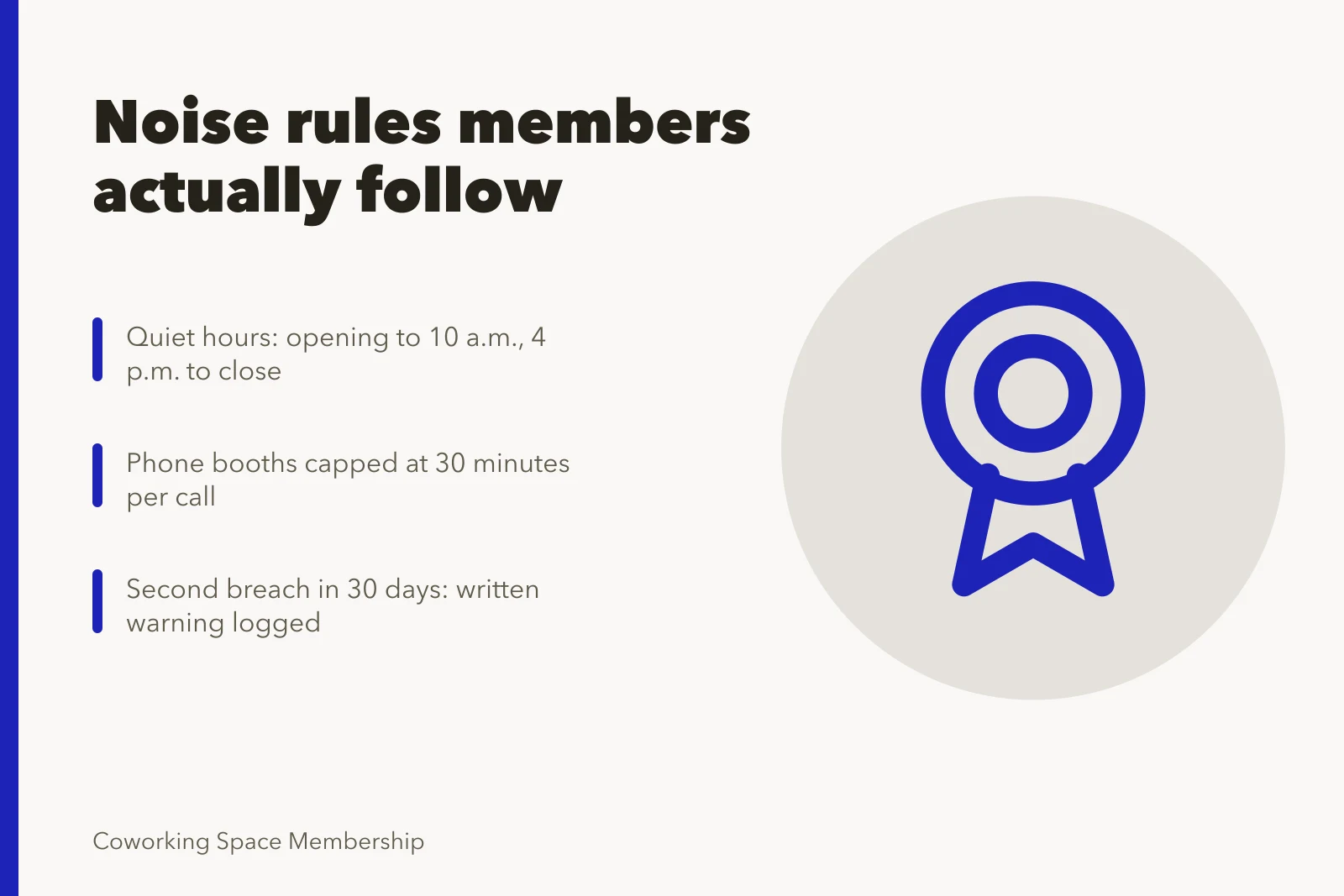
- Quiet hours in most US open-plan floors run from opening until 10 a.m. and again from 4 p.m. to close, which matches the two daily peaks in speech noise.
- Phone booths get a hard time limit, usually 30 minutes, plus a rule that calls move to a booth or outside the floor.
- The consequence that changes behaviour is a written warning after a second logged complaint, followed by a meeting room or day pass suspension.
- OSHA sets a workplace exposure limit of 90 dBA over an 8-hour day, which is a floor for safety, not a target for a shared desk floor.
Why open-plan floors in dense metros complain more
Dense downtown submarkets put more people into smaller floor plates. San Francisco and Chicago operators sell desks by the square foot, and the cheapest layout is a long open table with no partitions. Speech is the problem, not machinery. One person on a video call carries further than a printer or an HVAC vent.
Most members never file a complaint. They cancel. That is why the policy has to be written down and enforced by staff rather than left to social pressure. Operators who track this will recognise the pattern described in measuring service quality in a coworking space, where noise scores move before churn does.
The five policy examples members actually follow
These are the clauses that survive contact with a real membership. Each one is short enough to fit on a single laminated card at the front desk.
- Zone rule. Every desk is labelled Quiet, Standard or Collaborative. Quiet zones ban calls and speaker audio entirely. Standard zones allow calls under five minutes at the desk. Collaborative zones allow open discussion.
- Quiet hours. Calls and speaker audio are prohibited in Quiet and Standard zones from opening until 10 a.m., and again from 4 p.m. to close. Outside those windows, short calls are permitted at Standard desks with headphones.
- Phone booth limit. Booths are capped at 30 minutes per session, with a 15-minute gap before the same member can rebook. Booths are for calls, not for heads-down work.
- Headphone rule. Any audio played aloud in a shared zone is a breach on the first occurrence, with no warning. This covers music, video, and speakerphone.
- Meeting room overflow. When all booths are occupied, members take calls in a bookable meeting room at no charge for the first 30 minutes. Operators who price those rooms by the hour should read coworking space meeting room pricing: hourly vs monthly passes before writing the overflow clause, because a free 30 minutes can undercut a paid product.
A rule that no staff member will interrupt a call to enforce is not a rule. It is a suggestion, and members read it that way within a week.
What the acoustics actually require
The policy only works if the room supports it. Absorption matters more than signage. Felt panels on two facing walls, carpet or rug coverage on at least 60 percent of the floor, and a sound masking system set a few decibels above ambient speech will do more than any written clause.
NIOSH publishes hearing loss prevention guidance that operators often cite when setting internal thresholds. The practical number for a shared floor is lower than the regulatory one. A room where normal conversation at three metres is clearly intelligible will generate complaints no matter what the policy says.
| Zone | Calls allowed | Audio allowed | Typical placement |
|---|---|---|---|
| Quiet | No | No | Perimeter desks, library seating |
| Standard | Under 5 minutes | Headphones only | Main open tables |
| Collaborative | Yes | Headphones only | Project tables, lounge |
| Booth | Yes, 30 min cap | Headphones only | Core or corridor |
| Meeting room | Yes, booked | Speaker allowed | Enclosed rooms |
What happens if a member ignores it
Enforcement has to be graduated and logged, or staff will apply it unevenly and members will notice.
- First breach: staff tap the desk and ask for the change. No record kept.
- Second breach in 30 days: written warning sent by email, logged in the member record.
- Third breach in 90 days: booth and meeting room booking suspended for 14 days.
- Fourth breach in 180 days: membership reviewed, with the option to move the member to a Collaborative-only plan or end the agreement.
The concrete consequence is booking suspension. It costs the member something they use daily, is reversible, and avoids arguing about intent. Warnings alone do nothing.
For escalation to hold up, operators should apply the same logging discipline to staff. That is covered in coworking space training: what to cover and when.
Example: a one-page booth policy for a Chicago floor
The floor has 140 desks, four booths. The card says booths are for calls, 30 minutes maximum, 15-minute gap before rebooking, no exceptions during quiet hours for Standard desks.
Staff check booth occupancy every 15 minutes during the morning peak. If all four are full, the front desk opens Meeting Room B and posts the change on the member app.
The result operators report is not fewer calls. It is fewer calls at the wrong desk. That is the whole point of a noise policy.
Common questions
Do quiet hours need to be the same every day? No. Many US floors run a longer quiet block on Mondays and Fridays, when attendance is lighter and deep work is more common. Publish the schedule on the member app and keep it stable for at least a quarter.
Can a noise policy be enforced against a member on a day pass? Yes, and it should be. Day pass holders cause a disproportionate share of first breaches because they never read the handbook. Put the zone rules on the check-in screen.
What about members with a documented disability that affects volume control? Treat it as an accommodation request, not a breach. Title III of the ADA covers places of public accommodation, and the Department of Justice publishes guidance on those obligations through its Title III overview. Move the member to a booth-adjacent desk and document the change.
Is a decibel limit better than a behaviour rule? Rarely. Members cannot measure decibels and staff will not carry meters. Behaviour rules are enforceable at the desk, which is where the problem starts. Background on how noise rules are written elsewhere is available in this overview of noise regulation.
The policy is only half the job. The other half is the floor plan, and operators weighing a rebuild against a new lease should read Seattle coworking spaces vs Miami spaces, designing for climate and energy costs before committing capital to acoustic treatment.