Guides
Coworking space training: what to cover and when
Coworking staff training works when it maps to the desk, the door and the member contract, not to a generic onboarding template or a one-off tour.
What to take away
- Coworking training follows the physical product: desks, meeting rooms, the front door, the wifi, the coffee, and the member contract behind each one.
- Community managers, member services staff and access-control administrators need different depth on the same systems, so one checklist does not fit all three.
- OSHA's Emergency Action Plan page is the reference for evacuation, accountability and drill duties; the local fire authority sets what your building must actually do.
- Wage, overtime and timekeeping duties sit with the U.S. Department of Labor and your state labor office, not with a template.
- Every policy needs an effective date, an owner and a review date, or staff will keep using the old version.
This article covers coworking operations, not legal, tax or safety advice. Lease terms, occupancy limits, fire and accessibility rules, and employment duties vary by city, building and membership model. Confirm current requirements with your local authority having jurisdiction and a licensed attorney or CPA.
Train to the desk, the door and the contract
A coworking space sells three things: a place to sit, reliable infrastructure, and a membership agreement the member can trust. Training should mirror those three.
Front desk staff need the booking system, the access-control platform and the membership tiers cold. They need to know what a Day Pass includes versus a Dedicated Desk, when a meeting-room credit expires, and who approves a guest.
Community managers need the same systems plus the escalation path: a member whose keycard fails at 7am, a room double-booked, a noise complaint between two companies that share a floor.
Access-control administrators need the audit trail. Who issued that fob, when was it deactivated, and what happens when a member cancels mid-month but keeps the card.
A coworking onboarding sequence
- Days 1 to 3: tour, emergency exits, alarm panel, first-aid kit location, incident reporting form, and the member handbook.
- Week 1: booking software, access-control dashboard, billing platform, and the escalation tree with names and phone numbers.
- Week 2: shadow a full shift including opening and closing, mail handling, printer and wifi triage, and a member tour.
- Week 3: run a shift with a supervisor on call, handle one billing question and one access issue start to finish.
- Week 4: sign-off on the emergency action plan, the refund and credit policy, and the current price sheet.
Nothing here replaces the emergency plan your building requires. OSHA's Emergency Action Plans page lists the elements to cover:
- reporting
- evacuation routes
- accountability for who is still inside
- rescue or medical duties
- contacts
- training and plan review
In a shared workspace the accountability piece is the hard one, because you may not know who is in the building at 9pm.
Pay, scheduling and the legal floor
Coworking runs on thin margins and long opening hours, so scheduling is where labor cost hides. Build the shift plan from actual demand: Monday and Tuesday mornings fill meeting rooms, Friday afternoons empty out, and the front desk still needs coverage.
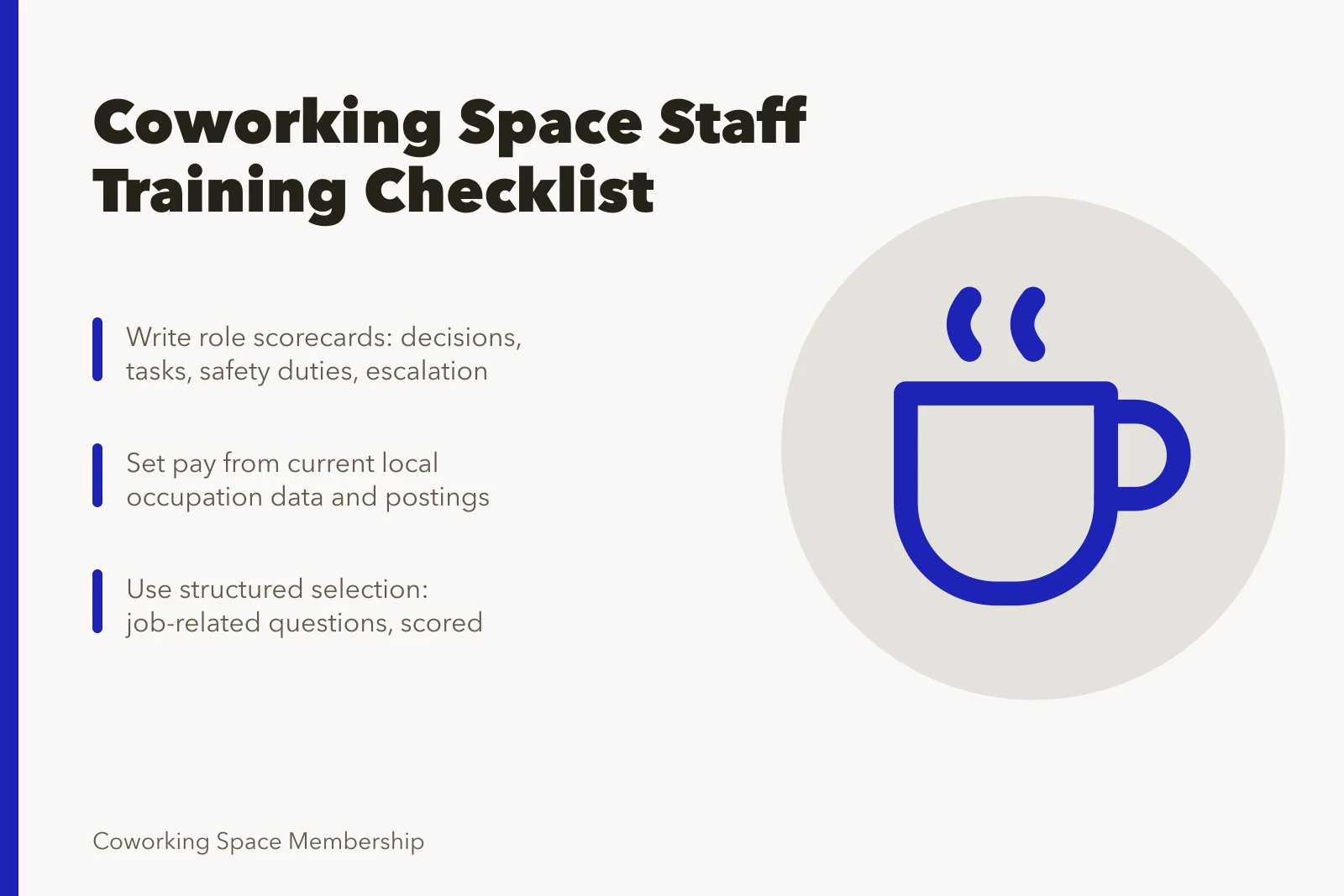
Wage and hour duties come from the U.S. Department of Labor small business guidance and your state labor office. That covers overtime for non-exempt staff, timekeeping, meal breaks and recordkeeping. Coworking spaces often misclassify a community manager as exempt when the role is mostly member service. Check the duties test before you assume.
Hiring decisions carry their own rules. The EEOC small business resource center covers nondiscrimination, accommodations and record retention. Ask every candidate the same job-related questions and keep the scoring.
For current pay ranges by market, see our breakdown of coworking space pay rates and labor costs in 2027.
Worked example: the failed keycard
A member messages at 6:45am that their fob will not open the door. Three staff members handle this differently.
The untrained response: apologize, tell them to wait, call the manager at 8am. The member loses an hour and posts about it.
The trained response: check the access log, confirm the membership is active, issue a temporary code, log the incident, and flag the fob for replacement. Total time: four minutes.
The difference is not attitude. It is whether the access-control dashboard, the temporary-code procedure and the incident log were covered in week one.
Common questions
Does a small coworking space need a written emergency action plan?
OSHA requires one for most employers with eleven or more employees, and many smaller spaces keep one anyway because their landlord or insurer asks for it. The plan must name evacuation routes, a headcount method and who calls 911. Your local fire authority has the final say on drills and posting requirements.
Who owns training records?
The operator does. Keep sign-off dates for each policy, the version number, and the date the employee completed it. If a wage claim or an incident review ever happens, that file is your evidence. Store it with the same care as the membership agreements.
How often should the checklist be reviewed?
At least once a year, and any time you change booking software, access hardware, membership tiers or pricing. A checklist that references a system you retired six months ago teaches staff to ignore the checklist.